Year 2003, Delhi Dehradun Highway. A CEO of an organization was travelling to Dehradun with his family. In between, somewhere his brand new Super Premium Car broke down (The car had done less than 5K kms). He called the nearest dealership. The dealership informed the Field Service Team. The Service Team shared the information with the Vehicle Quality (VQ/VI) team in plant. Then began the analysis and research on the problem.
i) Field Failures, VIN Card and Company Culture : In this particular car OEM, Field Failure and Customer Complaints were treated like ‘Quotes from the Bible’. Customer complaints were looked upon as Opportunities to Improve the Process Quality and Product Quality. And the Go To Point was the Vehicle Inspection Card (VIN Card) that used to be safely guarded and protected by Vehicle Quality (VQ).
(VIN cards used to be a proprietary document of VQ. That document used to contain all details of the particular car - from Frame Welding ->Paint Shop -> Engine Assembly -> Final Assembly -> Vehicle Quality (VQ) -> Delivery. And the VIN Card would bear the signature of each Operator, with time stamp, location stamp, and passing remarks, before the Vehicle was Okayed for the next operation/station.
Thus began the search on the Complaint. The VIN card was explored, problem was traced back to : To the shift -> to the work station -> to the tools used in that particular shift-> To the Operator(bearing his signature). On further investigation the Root Cause was identified and immediate Corrective Action for that particular model was in place.
The above situation highlights 03 Unique Features of Vehicle Quality/Vehicle Inspection in a Japanese Car Manufacturing Process:
1. Traceability of Problem
2. Fixing of Ownership (Accountability)
3. Quick Turn Around and establishing Permanent Corrective Action(PCA)
Inclusive Manufacturing : The Joy of Buying, the Joy of Selling and The Joy of Making Cars – that was Soichiro Honda’s Thought Process of Inclusive Manufacturing which he started way back in 1960s..
ii) AI Certification Process : Given the rapid adoption of AI and the fast changing landscape for AI, there is a Global Need for the Creation, Adoption and Certification of a Regulatory Framework and a Compliance Guideline for AI. The objective of this paper is to establish a Traceability Matrix for AI, setting up a Framework of Accountability for the user community, and Fixing a Responsibility on the Developer and Owner community of the AI.
(There exists similar acts/regulation in different geographies like the EU Act, NIST etc. All these cover some essence of the above. This paper is trying to address The Traceability Matrix and the Accountability Matrix.)
ISO/TS Format : To be able to achieve the Traceability Matrix and Accountability Matrix of AI, AIs needs to be brought under Audits and Inspection process (like in the ISO/TS Format)
Like the ISO/TS Standards, AIs should be subject to Certification Process. So, with Certification process of AI, we are likely to have Certification Audits, Surveillance Audits, Compliance Audits, Re-Certification Audits, Process Documents and Guidelines, Quality Manual, Internal Discussions and Internal Reviews with Operational Levels; Discussion and Reviews with Management Team. This process would address Management Audits, System Audits, Process Audits, Data Audit, Algorithm Audit, Bias Audit, time to time Inspections of the AI environment etc. The AI developer community would understand the importance of Audits and Compliance w.r.t. local laws, government laws, regulatory restrictions, and would try to work under a Compliance Framework.
The Entire Ecosystem of AI would come under a Mechanism of Audits, Inspection and Surveillance and Accountability under the given Government Laws.
iii) Proposal :
- QMS System : To design and develop a complete Quality Management System(QMS) for AI developer and user community
- Responsibility Management System(RMS): To design and develop a complete Responsibility Management System(RMS) for AI developer and user community
- Accountability Management System(AMS) : To design and develop a complete Accountability Management System(AMS) for AI developer and user community
- Quality Manual : Quality Manual that describes organizations Quality Management System, Quality Policy, Responsibility Policy, Accountability Policy, Responsibility Matrix, Accountability Matrix, outlining processes, responsibilities, and procedures to ensure consistent quality and compliance with ISO/IEC 42001 standards( and more..)
- Responsibility Manual for the AI, Design Documents, Process Documents, Data Source Documents, and user community
- Accountability Manual for AI, Design Documents, Process Documents, Data Source Documents for AI user community
- Data Management System : Definition of Data, Identification of Data, Classification of the Data Type, Establishing the nature of data (biased, unbiased or Neutral data), Selection of Biased Data, Filtration of the data, and next corrective action on Data Bias
- Bias Management System : Definition of Bias(w.r.t. context), Identification of Bias(w.r.t. context), Establishing the Bias, Selection of Bias and Filtration of Bias, and next corrective action on Bias
- Algorithm Management : Study and Analysis of Algorithm, identification of Bias in Algorithm, Adjustments and Management of the Weights in the Algorithm
- Framework and Guideline Management System for Responsible AI for the Developers Community and for the User Community
Output of the above Process :
Take Away for Industry: Evolution of a Global Structure for Adequate Reliability and Responsible Usage on AI tools and it's related outputs.
Classification of AI: Identification, Classification and Certification of AI as Technical AI, Philanthropic AI, Suitable AI, Reliable AI, Benign AI, Malignant AI, Rogue AI etc
Categorization of AI (Red, Yellow, Blue, Green): Based on Environmental Impact, Water Usage
Star Rating of AI (3*,4*, 5*): Based on Energy Consumption, Heat Generation, AI Infrastructure and Data Centers cooling efficiency
Flagging of AI (Red flag, green flag, yellow flag): Based on the Social Impact of AI on Society and People and Nations, AI will need to be identified/cautioned/flagged
Grouping and Classification of AI : AI for Medicine Research, AI for Industry Usage, AI for Healthcare, AI for Insurance providers, AI for financial Management etc
Output of AI Generated Images/PDFs: There needs to be id/time stamp/water mark of the user; and id/name of the AI used, location details etc. This will be able to create traceability and accountability on the AI developer and user community for image generation and its circulation.
(Other areas of AI output like generated texts, generated voice messages etc – further study, research and analysis is required so that these outputs are also covered in the paradigm of audits)
iv) Bias Management : The definition of Bias needs to be understood w.r.t context, w.r.t. data selection, w.r.t. classification/grouping of data, and then defined in the Responsibility Matrix/Accountability Matrix w.r.t. usage of AI.
What is biased for A, may appear unbiased for B, what is neutral for C, may appear lethal for D.
What is good for a region may be unsuitable to other region. What is good for a group may be offensive to another group. As a result, for an AI to be unbiased, we may have to Balance the Data that goes into training the AI.
Biased Data : Let us take a hypothetical situation of Data Bias. If an AI is fed all the social data from a particular location, which has extremely Good Track Record of Philanthropy towards mankind, the AI Naturally Learns that people from this area are all A+ Citizens. This leads to Creation and Generation of Data Bias within the AI, because it has been fed with data that has a Natural Bias within the data.
UnBiased Data : To offset the Data Bias, we need to feed the system with ‘Balanced Data’ which does not have any inclinational or skew towards any particular demography/location etc.
“Balanced data can make sure that the model can learn suitably from all classes, leading to unbiased predictions or leanings. (With an imbalanced data, the model may become biased toward the majority class. This may result in poor performance on the minority class. This can lead to misleading accuracy metrics, as the model might predict the majority class correctly most of the time but fail to generalize well for the minority class.)”.
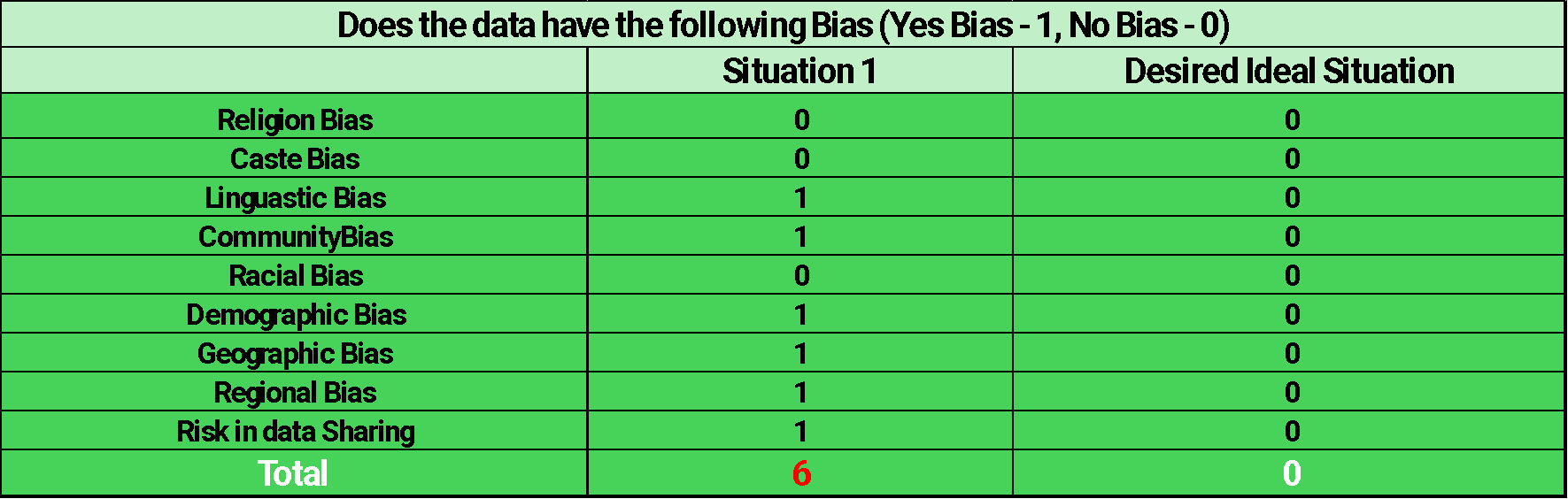
(The above image describes the Algorithmic Test for Bias)
v) Consciousness : We Human Beings have been blessed with an Unique id and we know it as Consciousness. Consciousness allows us to think. Consciousness allows us to Realise. The ability to think inculcates a sense of Being and Belongingness to people and Societies around us. This ability to think makes us Accountable for our actions, the ability to think inculcates a Sense of Responsibility within us, the ability to think makes us Sensitive and allows us to Retain our Moral Values. Justness and Fairness, Social Justice and Empathy, Security and Freedom they are all indicators of our level of Consciousness. The more Conscious we are, the more Responsible we are to society and to people and to mankind around us.
However, our dependence on AI and usage of AI in our daily lives seems to be devoid of the One Unique Human Value – Consciousness. Since we talk about the ability of AIs to Self Learn and to replicate results quickly, we need to establish a process if AIs are capable of Inculcating Human Values, adequately and quickly !!
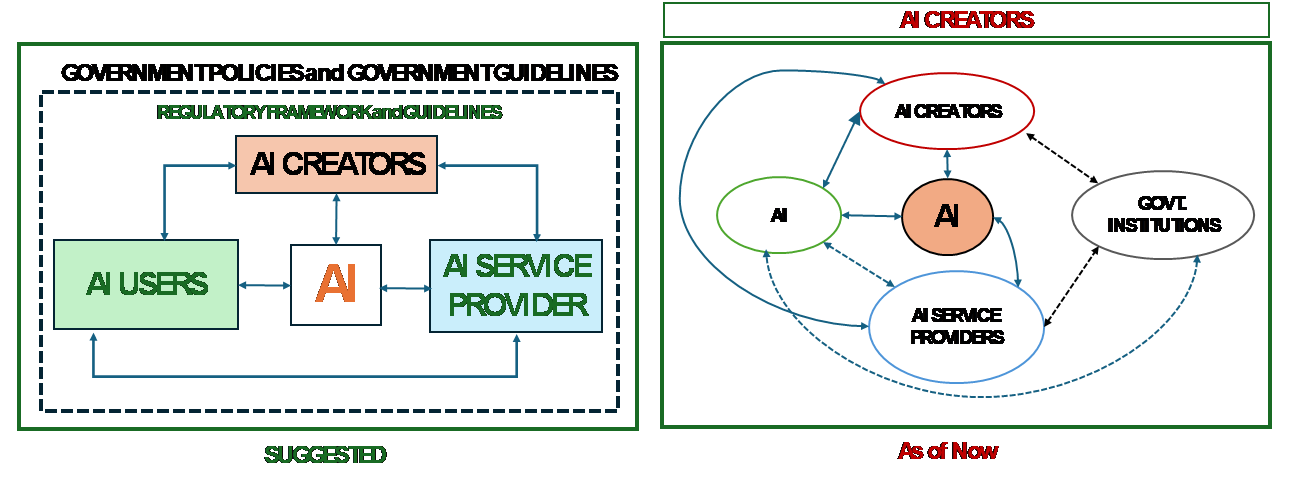
vi) Responsibility and Accountability Matrix : Responsible Users and Accountable User/Developer – This is again a subject of Research and Development. Below is a matrix to explain the need. But more work needs to be done.
(How the Accountability Matrix and Responsibility Matrix will be built is again a process of Research and Development)
vii) Framework for Algorithm Audit : The Intent of the template is to create an Algorithm, based on the below Logic, run the Algorithm and confirm the results of the Test Run, with intention of Auditing the Data and Algorithm. The No Risk carries ‘0’, Yes Risk carries ‘1’.
Is the AI Responsible for its outputs : 0 for Yes, 1 for No.
Is the AI Neutral for its outputs : 0 for Yes, 1 for No : 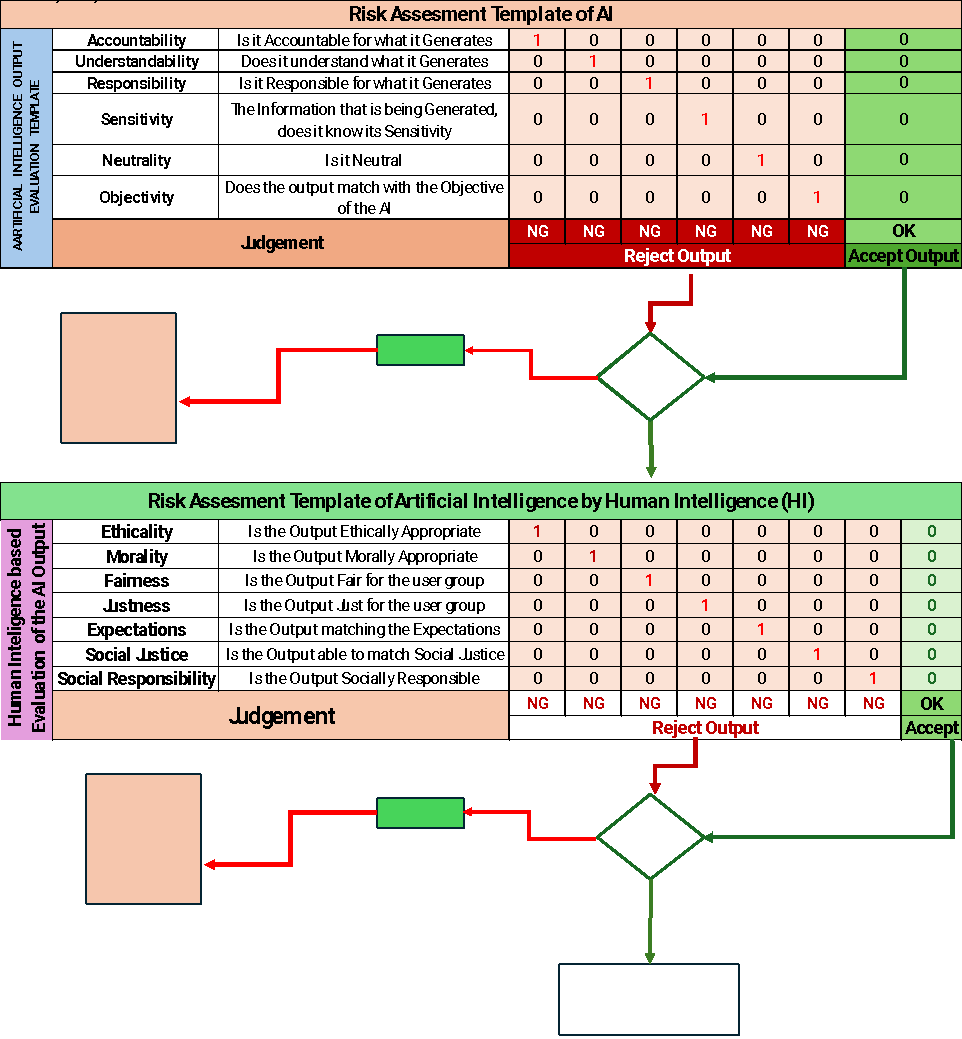
Based on the above Template, an Audit Algorithm can be developed and deployed to audit the Yes Bias/No Bias of the AI data and the AI Algorithm.(The above is a subject of Research and Thinking.)
Existing Framework and Guidelines for AI
Conclusion : As I scroll through different authors and thinkers of AI, a few thoughts come to me naturally :
1. If data Audit is to be done, how will it be done - Will it be manual scanning of thousands of pages of documents OR will it be through another AI tool? If it is through an AI tool, do we also need to scan this AI tool for further Audits?
2. If Algorithm Audit needs to be done, will it be done by another S/W tool or are we going to use an AI tool to do audit?
As I read and learn and think on AI, I plan to share my Curiosities, Questions and Thoughts to the Industry, so that I my queries are adequately guided for further enhancement of AI !!
Acknowledgements and Inspirations :
- Dr. Rajiv Malhotra : Artificial Intelligence and the Future of Power: 5 Battlegrounds
- Eric Schmidt, Mustafa Suleyman, Jeff Hawkins, Kai Fu Lee, Ray Kurtzwell, Peter Song
- Reviews: Faculty of AI, IITD; Faculty of AI, CU
Author: Bhaskar Nandi
The author is a Consultant with an IT Organisation. He has worked for Honda, Hyundai Motors and Mahindra and Mahindra in Quality and Field Service. He is TUV-SUD Certified Lead Auditor for ISO: 9000. The author is pursuing Research in AI. The views expressed are based on his Research and Study on Responsible use of AI.